
What if the single greatest opportunity for your business growth is happening right now, and you’re not fully capitalizing on it?
You are standing at the forefront of a massive economic shift. This technological revolution is reshaping how companies operate. It’s not just a trend; it’s a fundamental change in the competitive landscape.
The numbers speak for themselves. Globally, artificial intelligence is projected to add an astonishing $15.7 trillion to the world economy by 2030. For the local market, the potential is equally staggering, with projections reaching $366 billion for the national GDP.
This aligns perfectly with ambitious government goals. The target is for the digital sector to contribute significantly to the economy, aiming for 8% by 2025. The overall digital economy is projected to hit $600 billion.
Navigating this complex environment requires expert guidance. For tailored insights and implementation support, you can connect with Dee Ferdinand A.I Digital Consulting at +6281289633588 or follow @deeferdinand.
Key Takeaways
- The global economic impact of intelligent systems is projected to be monumental by 2030.
- The local market holds a massive share of Southeast Asia’s total economic potential from this technology.
- Government initiatives have set clear and ambitious targets for digital sector contribution.
- Early adoption of these advanced technologies is a strategic imperative for business growth.
- Expert consultation is available to help businesses navigate this transformative landscape effectively.
- National development plans position technological advancement as a cornerstone for future progress.
Understanding Global AI Trends and Digital Transformation
Nations worldwide are racing to harness the power of intelligent technologies for economic advantage. This global transformation affects every sector from healthcare to public services. Understanding these trends helps you position your organization for success.
Impact of AI on Global Economies and Sectors
International Data Corporation projects spending on intelligent systems will reach $632 billion by 2028. This massive adoption drives efficiency across entire economies. Organizations report 42% cost reductions and 59% revenue growth through proper implementation.
The healthcare sector shows remarkable innovation. The FDA approved 139 AI-based medical devices in 2022. Research tools like EVEscape advance medical discovery at unprecedented speeds.
Lessons from International AI Initiatives
Countries demonstrate successful technology application through coordinated policies. The European Union establishes ethical standards while China leads in patent development. These government initiatives create frameworks for responsible innovation.
Singapore’s Smart Nation program optimizes traffic management through data analysis. Estonia uses chatbots for citizen services, reducing workloads. Ecuador’s education system improved teacher placement with advanced algorithms.
Your strategic planning benefits from studying these international models. They show how research, development, and management systems work together. This knowledge helps you avoid common pitfalls in technology adoption.
The Emergence of AI Digital Strategy Indonesia
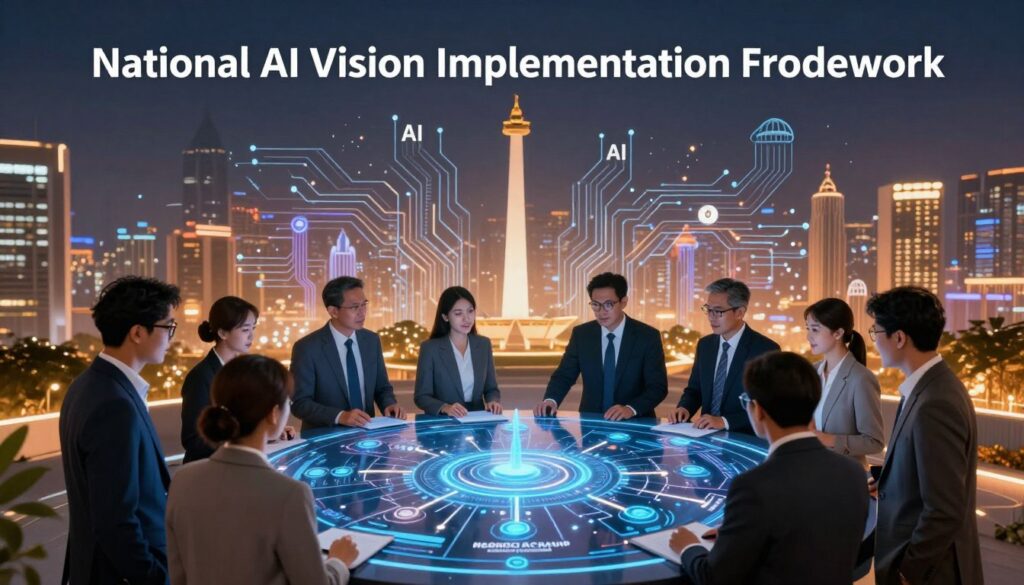
Indonesia’s commitment to technological transformation is evident in its structured national approach. The government has established a comprehensive framework that guides systematic development across key economic sectors.
National AI Vision and the Golden Indonesia 2045 Framework
The National Strategy for Artificial Intelligence Implementation 2020-2045 provides clear direction. This vision aligns perfectly with the Golden Indonesia 2045 goals. It positions technological advancement as essential for national progress.
Five priority sectors form the foundation of this strategy. Healthcare, bureaucratic reform, research and education, food security, and smart cities receive focused attention. Each sector follows specific implementation frameworks.
Local Adoption and Government Initiatives
Presidential Regulation No. 82/2023 accelerates digital transformation across government services. This legal framework supports the Electronic-Based Government System (SPBE). It enables comprehensive service integration.
Seven specialized working groups oversee different aspects of implementation. These groups cover ethics, policy, infrastructure, research, talent development, investment, and use cases. This ensures systematic progress across all dimensions.
| Priority Sector | Focus Areas | Key Initiatives |
|---|---|---|
| Healthcare | 4P Framework | Predictive, preventive, personalized services |
| Bureaucratic Reform | Automation & Efficiency | Budget monitoring, proposal analysis systems |
| Research & Education | Talent Development | AI Talent Factory, Digital Talent Scholarship |
| Food Security | Sustainable Production | Data-driven agricultural optimization |
| Smart Cities | Urban Management | Integrated mobility and service systems |
The nation aims for a 25% annual increase in trained professionals. Programs like AI Talent Factory address critical skill gaps. This talent development initiative supports long-term growth objectives.
Key Sectors Driving Indonesia’s Digital Revolution
From urban centers to rural communities, advanced systems are revolutionizing how essential services operate. These transformations demonstrate practical applications that benefit millions of citizens daily.
Healthcare, Education, and Bureaucratic Reforms
The healthcare sector embraces a comprehensive “4P” framework. This approach enables predictive, preventive, personalized, and participative services.
Educational institutions implement adaptive learning systems. These technologies adjust material based on individual student abilities.
Bureaucratic reforms automate repetitive government tasks. Systems now monitor budgets and identify inconsistencies in proposals.
| Priority Sector | Key Innovation | Impact Measurement |
|---|---|---|
| Healthcare | 4P Framework Implementation | Proactive disease prevention |
| Education | Adaptive Learning Systems | Personalized student outcomes |
| Bureaucratic Reform | Automated Budget Monitoring | Workload reduction up to 40% |
| Food Security | Satellite Imagery Analysis | Crop yield improvement |
| Smart Cities | Traffic Management Systems | Congestion reduction |
Smart City Development and Public Service Innovations
Urban centers demonstrate remarkable progress in public service delivery. Surabaya’s traffic management system uses computer vision from CCTV cameras.
“The integration of advanced technologies into urban infrastructure represents a fundamental shift in how cities serve their residents.”
Jakarta addresses congestion by adjusting traffic light timings using real-time data. West Java pioneers disease surveillance through medical record analysis.
These innovations showcase how data-driven approaches transform essential services. The results include improved efficiency and better quality of life.
Deep Dive into Trend Analysis and Research Findings

Data-driven analysis uncovers significant opportunities for organizations prepared to embrace innovative approaches. Current research reveals unprecedented economic potential across global markets.
Latest Data on AI and Economic Impacts
PwC research projects a staggering $15.7 trillion contribution to the global economy by 2030. The local market stands to capture $366 billion of this value.
IDC forecasts global spending reaching $632 billion by 2028. This investment momentum creates remarkable opportunities for strategic positioning.
Local adoption rates demonstrate exceptional momentum. 92% of knowledge workers already use generative tools, surpassing regional averages. Jakarta emerges as a leading hub for technology interest.
Comparative Insights from Global and Local Reports
A significant governance gap exists despite high recognition of technology’s importance. While 93% of business leaders acknowledge its competitive value, only 24% have established clear frameworks.
Major investments demonstrate strong confidence in local infrastructure development. Microsoft’s $1.7 billion commitment and NVIDIA’s $200 million center highlight this trend.
The World Economic Forum identifies analytical thinking, flexibility, and creativity as essential skills. These competencies represent critical learning requirements for workforce preparation.
Your approach should balance tremendous potential with realistic implementation challenges. Enhanced research funding and systematic governance frameworks ensure responsible deployment.
Digital Governance and Enhanced Public Services
Modern public service delivery requires a fundamental shift toward data-driven governance models. Presidential Regulation No. 82/2023 establishes the Electronic-Based Government System (SPBE) as the foundation for this transformation.
This framework enables comprehensive service integration across all levels of administration. The result is a more responsive and accountable government structure.
AI in Modernizing Government and Infrastructure
Your operations gain significant efficiency through intelligent automation. Virtual assistants handle routine inquiries, freeing staff for complex citizen needs.
Predictive maintenance systems analyze infrastructure data to prevent service disruptions. This approach ensures continuous delivery of essential utilities and transportation.
The Ministry of Administrative and Bureaucratic Reform developed clear indicators for successful implementation. These metrics cover data management, security protocols, and coordination effectiveness.
Transparency, Efficiency, and Risk Management
Your governance approach benefits from enhanced transparency mechanisms. Open data initiatives make government information accessible to all citizens.
“Intelligent systems transform how institutions maintain public trust through verifiable operations.”
Pattern recognition technologies identify potential fraud and cybersecurity threats. This protective layer safeguards sensitive citizen information effectively.
IKN’s Smart Governance blueprint demonstrates integrated emergency response capabilities. Command centers coordinate rapid assistance during crises using real-time data analysis.
Implementing Your AI Digital Strategy in Indonesia
Your organization’s transformation journey requires a clear roadmap with practical steps that deliver measurable results. Begin with a comprehensive assessment of your current infrastructure and workforce capabilities.
Identify specific areas where intelligent systems can improve operational effectiveness. Focus on high-impact applications like traffic management or predictive analytics.
Practical Steps and Best Practices for Transformation
Your approach must prioritize capacity building through systematic training programs. Develop skilled professionals who understand local market challenges.
Establish robust data governance frameworks that ensure quality and security. Comply with personal data protection laws while supporting sophisticated algorithms.
Foster public-private partnerships that leverage collective expertise. This collaboration accelerates progress across the entire ecosystem.
“Successful implementation balances innovation opportunities with responsible risk management.”
Initiate pilot projects for iterative improvements and scalability. Learn from successful local initiatives while avoiding common pitfalls.
Contact Industry Experts
You can accelerate your progress by engaging experienced consultants who understand the local landscape. Reach out to Dee Ferdinand A.I Digital Consulting at +6281289633588 or follow @deeferdinand.
Their expertise helps navigate regulatory requirements and identify high-value use cases. Get tailored guidance for your organization’s unique needs and goals.
Conclusion
Your organization’s future success hinges on understanding and leveraging the current wave of intelligent system implementation. The potential for growth is immense when you align with national development goals.
Indonesia’s comprehensive vision creates a supportive ecosystem for technological adoption. From healthcare to urban traffic management, proven applications demonstrate real progress.
While challenges exist in infrastructure and governance, these are surmountable with proper planning. Your role in this transformation requires decisive action now.
Take the next step today by contacting Dee Ferdinand A.I Digital Consulting at +6281289633588 or following @deeferdinand. Their expertise will help you navigate this landscape effectively.