
What if your competitors are already using smart technology to outperform you, and you don’t even know it?
This isn’t science fiction. Machine learning and digital tools are reshaping markets right now. Your company in Indonesia’s capital can lead this change.
Welcome to a new era of innovation. Specialized education brings these powerful tools to your entire team. From executives to frontline staff, everyone gains practical skills.
The right knowledge transforms organizations. It future-proofs them against rapid technological shifts. This is about staying ahead in a dynamic economy.
Forget theoretical lectures. We focus on actionable learning that delivers measurable results. You’ll see real-world applications that boost efficiency and growth.
Adopting these systems is a strategic journey, not a technical hurdle. We make it manageable and rewarding for leaders like you.
This guide shows what effective skill development entails. Learn how programs can be tailored for enterprises in this vibrant metropolis.
Key Takeaways
- Smart technology is a present-day tool for competitive advantage, not a distant future concept.
- Practical education should involve your entire organization, from leadership to operational staff.
- The right learning program transforms companies and protects them against rapid change.
- Effective skill development focuses on real-world application and measurable outcomes.
- Adopting digital tools is a strategic, manageable journey for business leaders.
- Programs can and should be customized to meet the specific needs of enterprises in Indonesia’s capital.
- This comprehensive guide explains what to look for in a quality educational experience.
Is Your Jakarta Business Ready for the AI Revolution?
How many hours does your team waste on tasks that smart systems could handle in seconds?
This technological shift isn’t coming. It’s already here. Across the globe, intelligent algorithms are reshaping entire sectors. From retail to finance, early-adopting companies gain massive advantages.
In Indonesia’s capital, this digital wave creates both immense opportunities and fierce pressure. Your competitors might be automating processes you still do manually.
Common signs indicate when an enterprise falls behind. Reliance on spreadsheets for data competitors analyze instantly is one red flag. Another is lacking staff who understand these powerful tools.
This skills gap creates real vulnerability. Manual workflows slow everything down. Innovation cycles stretch longer than they should. More agile rivals can disrupt your market position.
The risks of waiting are substantial. You miss efficiencies that boost profit margins. Customer insights remain hidden in unanalyzed data. New market entries become reactions rather than initiatives.
Conversely, the rewards for proactive organizations are tangible. Streamlined operations cut costs dramatically. Enhanced decision-making comes from predictive analytics. You can personalize customer experiences at scale.
Early adopters don’t just keep up. They lead. They enter new niches first. They build stronger client relationships through data. Their entire operation becomes more resilient.
Remember, readiness is a spectrum. No company starts perfectly prepared. The goal of skill development is systematic movement. You progress from current capabilities to true proficiency.
This revolution represents an inevitable wave of change. Specialized education provides the essential vessel. It equips your team to navigate these waters successfully.
Your journey begins with honest assessment. Then comes strategic upskilling. The result is a transformation that future-proofs your entire operation.
Why Your Team Needs AI Skills Now

Your team’s collective intelligence is the single most powerful asset you have for navigating technological change. Investing in their development isn’t just about new tools. It’s about unlocking their full potential.
Understanding smart systems is quickly becoming as essential as using email or a spreadsheet. This new literacy allows your people to work effectively alongside advanced software. They stop being confused users and become empowered collaborators.
Upskilling your staff sends a powerful message. You are investing in their professional future. This builds loyalty, boosts morale, and helps you retain top talent who want to stay relevant.
When different departments share this knowledge, magic happens. Silos break down. Marketing can brainstorm with IT. Finance can partner with operations. This cross-functional understanding sparks collaboration on projects that use intelligent technology.
You create internal champions who spot opportunities everywhere. These employees can identify practical use cases, manage external partners, and drive adoption from within. They become your go-to source for smart solutions.
“The goal isn’t to replace people, but to augment them. It’s about elevating human work to be more creative and strategic.”
This addresses a common fear. The focus is on augmentation, not displacement. These skills free your team from tedious tasks. They can then focus on higher-value activities that require human judgment, empathy, and innovation.
Ultimately, this investment shapes your company’s culture. It builds a mindset of innovation, agility, and long-term resilience. It’s a core part of your growth strategy.
Empowering your people with this education prepares your entire organization for the future. It turns potential disruption into a sustained advantage.
What is AI Training for Business Jakarta?
What separates generic online tutorials from a curriculum that transforms how your organization operates? The answer lies in specialized, localized education designed for real-world impact.
This service builds enterprise-wide competency with intelligent systems. It’s not about abstract theory. The focus is on practical application within your specific company context.
Think of it as a bridge. It connects the potential of artificial intelligence to profitable implementation. Your teams gain the knowledge to make this technology work for them.
The scope is comprehensive. It covers everything your company needs:
- Foundational literacy for all employees
- Deep technical upskilling for specialists
- Strategic workshops for leadership teams
Every session addresses Jakarta’s unique market dynamics. Local case studies make concepts immediately relevant. You learn what works here, not in a generic global context.
Outcomes are tangible and practical. Teams finish with clear implementation roadmaps. Technology becomes demystified and approachable.
“Our expert-led workshops build the knowledge, capabilities, and confidence teams need to thrive in an AI-enhanced environment.”
This differs completely from standard online courses. Customization is key. Instructors adapt content to your industry challenges and opportunities.
Direct interaction creates deeper understanding. Participants ask specific questions about their work. They receive guidance applicable to their daily tasks.
The program develops true proficiency, not just awareness. Employees learn to identify use cases within their departments. They become internal champions for intelligent solutions.
This education transforms how people view digital tools. Fear of displacement gives way to excitement about augmentation. Staff discover how to elevate their strategic roles.
Ultimately, it’s about building a resilient, future-ready organization. The right learning experience turns potential into performance. It ensures your investment delivers measurable returns.
Building Foundational AI Understanding for Everyone
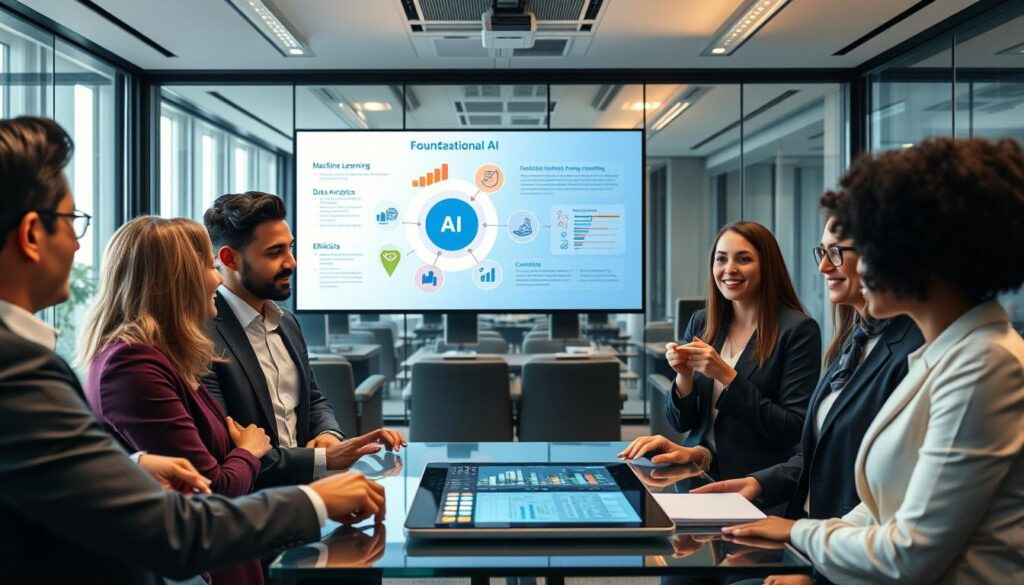
Before diving into complex applications, every organization needs a common baseline of technological literacy. This first pillar ensures all employees grasp core concepts.
Universal comprehension creates fertile ground for innovation. It turns confusion into confidence across departments.
Specialized programs build this essential foundation. They make intelligent systems accessible to everyone, regardless of role.
This foundational layer reduces fear and fosters informed conversations. It establishes a shared vocabulary about digital tools.
Your teams can then collaborate more effectively. They speak the same language when discussing opportunities.
Executive AI Literacy Workshops
Leadership teams require focused, strategic sessions. These workshops provide the knowledge to make informed decisions.
Content centers on business implications rather than technical details. Leaders explore return on investment and risk management.
They learn to evaluate potential projects and plan investments wisely. The guidance helps them steer organizational transformation.
According to ADDA’s programs, these are concise and intensive. They equip executives with practical insights for strategic planning.
AI Fundamentals and Demystification Sessions
These programs break down complex jargon into understandable terms. Employees learn how machine learning actually works.
The training sets realistic expectations about capabilities and limitations. It explains what intelligent tools can and cannot do.
Participants gain clarity on generative systems and predictive analytics. Common misconceptions are addressed directly.
This accessible education builds confidence across all levels. Staff move from uncertainty to practical understanding.
AI Ethics and Responsible Use Training
Responsible implementation is non-negotiable. This component covers critical ethical considerations.
Teams explore topics like data privacy and algorithmic bias. They learn to establish governance frameworks for safe deployment.
Transparency and accountability become central to their approach. The use of technology aligns with company values.
ADDA’s programs build understanding of potential pitfalls. They provide frameworks for ethical decision-making.
| Program Component | Primary Audience | Key Focus Areas | Outcome |
|---|---|---|---|
| Executive Literacy Workshops | C-suite & Senior Leaders | Strategic ROI, Risk Management, Investment Planning | Informed strategic decision-making |
| Fundamentals & Demystification | All Employees | Core Concepts, Realistic Expectations, Jargon Breakdown | Universal comprehension & reduced fear |
| Ethics & Responsible Use | Implementation Teams & Leaders | Data Privacy, Algorithmic Bias, Governance Frameworks | Safe, ethical deployment practices |
This universal understanding forms the bedrock for advanced skills. It creates alignment before specialized development begins.
Your entire organization gains a solid starting point. From this foundation, role-specific capabilities can be built effectively.
Expert facilitators ensure concepts are clear and engaging. They translate complexity into actionable knowledge.
The result is a workforce ready to embrace intelligent tools. They approach technology with confidence rather than apprehension.
Developing Technical AI Skills for Your Specialists
The true engine of digital transformation is a team equipped to build, not just use, smart solutions. This phase focuses on your technical talent—data analysts, developers, and IT professionals.
They will construct, manage, and evolve your intelligent systems. Deep, practical knowledge turns them into invaluable internal resources.
Specialized programs accelerate careers. They empower your people to lead technical initiatives. This reduces reliance on external vendors and builds self-sufficiency.
Data Science and Machine Learning Engineering
Effective solutions start with robust data science. This training covers the core disciplines needed to create powerful models.
Your teams learn statistical analysis and data manipulation. They master visualization techniques essential for intelligent work.
Machine learning engineering skills are developed in parallel. This includes model development and feature engineering.
Participants explore algorithmic approaches and model evaluation. They learn to select the right tool for each business challenge.
According to ADDA’s Technical Skills Development, this creates a solid foundation. Specialists gain the ability to prepare data and build reliable predictive systems.
Programming for AI: Python and R
Python and R are the essential languages of modern intelligent development. Hands-on coding workshops make these languages accessible.
Your developers learn to use powerful libraries like TensorFlow and PyTorch. They also work with scikit-learn for practical machine learning tasks.
This isn’t about abstract syntax. Sessions focus on writing code that solves real problems. Teams build small applications relevant to your operations.
The goal is practical implementation. Your specialists finish with the confidence to develop and deploy custom scripts. They can automate processes and create new tools.
Cloud AI Platform Mastery (AWS, Azure, Google Cloud)
Most enterprise-grade systems are deployed in the cloud. Understanding these ecosystems is non-negotiable for scaling solutions.
Training provides hands-on experience with major platforms. This includes AWS SageMaker, Azure Machine Learning, and Google Vertex AI.
Your team learns where and how to train models at scale. They understand deployment pipelines and monitoring tools.
This knowledge connects technical work directly to business infrastructure. It ensures your projects are built on a scalable, secure foundation.
Cloud mastery turns ideas into live, functioning systems. It bridges the gap between development and operational reality.
| Technical Skill Area | Core Learning Objectives | Key Tools & Platforms | Direct Business Outcome |
|---|---|---|---|
| Data Science & ML Engineering | Statistical analysis, data preparation, model development, evaluation | Pandas, NumPy, specialized ML algorithms | Build accurate predictive models and data-driven solutions in-house |
| Programming (Python/R) | Hands-on coding, library implementation, script automation | Python, R, TensorFlow, PyTorch, scikit-learn | Develop custom applications and reduce dependency on off-the-shelf software |
| Cloud Platform Mastery | Model deployment, scalable training, cloud infrastructure management | AWS SageMaker, Azure ML, Google Vertex AI | Deploy and scale intelligent systems efficiently, optimizing operational costs |
Investing in these technical skills delivers clear returns. Your company gains the ability to develop custom applications.
Existing systems can be optimized by your own experts. This strategic upskilling future-proofs your technical workforce and your entire operation.
Applying AI to Your Specific Business Functions

The real power of intelligent systems emerges when they’re woven directly into your department’s daily routines. This is where theoretical knowledge transforms into practical advantage.
Specialized workshops bridge this crucial gap. They show your teams how to apply concepts to their actual challenges.
According to ADDA’s Business Application Workshops, this phase delivers tangible returns. Employees learn to directly use tools for their specific goals.
Adoption becomes relevant and practical. It’s driven by actual needs, not just technological curiosity.
AI-Enhanced Decision Making Workshops
These sessions teach teams to interpret forecasts and simulations. They combine human expertise with machine-generated insights.
The result is faster, more accurate strategic choices. Your people learn to trust and validate smart recommendations.
Operational decisions improve dramatically. Teams can respond to market shifts with confidence.
They practice using predictive analytics in realistic scenarios. This builds capability for combining different information sources.
Function-Specific AI for Marketing, Sales, and Operations
Tailored sessions address each department’s unique workflows. Generic concepts become concrete applications.
Marketing teams explore personalized customer journeys. They learn to use systems for dynamic content creation.
Sales departments master predictive lead scoring. This helps prioritize outreach for maximum conversion.
Operations staff study logistics optimization. Predictive maintenance reduces downtime and costs.
Finance and HR receive their own relevant instruction. Every team gets tools for their specific work.
Process Redesign and AI Project Scoping
This training provides methodologies for auditing existing processes. Teams learn to pinpoint automation opportunities.
They develop skills for reimagining workflows. The goal is to incorporate new capabilities effectively.
Formal project scoping becomes a key focus. Participants define clear goals, resources, and success metrics.
They learn to evaluate and define initiatives properly. This ensures pilot projects have measurable outcomes.
| Business Function | Core Application Focus | Key Tools & Methods | Expected Outcome |
|---|---|---|---|
| Marketing | Personalized customer journeys, dynamic content, campaign optimization | Predictive analytics, segmentation algorithms, content generators | Higher engagement rates, improved conversion, better ROI on campaigns |
| Sales | Predictive lead scoring, opportunity forecasting, automated outreach | Lead prioritization models, conversation analytics, CRM integration | Increased win rates, shorter sales cycles, more efficient resource use |
| Operations | Logistics optimization, predictive maintenance, supply chain analytics | Route optimization algorithms, sensor data analysis, demand forecasting | Reduced costs, minimized downtime, improved resource allocation |
| Finance | Fraud detection, risk assessment, automated reporting | Anomaly detection models, predictive risk scoring, document processors | Enhanced compliance, faster reporting, reduced financial risk |
| Human Resources | Talent acquisition, employee retention analysis, skills gap identification | Resume screening systems, sentiment analysis, workforce planning tools | Better hiring matches, improved retention, strategic workforce development |
This practical approach ensures adoption is meaningful. Employees see immediate relevance to their daily operations.
The return on investment becomes visible here. People apply what they learn to real business challenges.
Each department develops its own use cases. They become internal champions for intelligent solutions.
This phase transforms general awareness into departmental capability. It’s where strategic vision meets practical execution.
Empowering Leaders to Guide AI Transformation
Who ultimately determines whether your company’s technological evolution becomes a story of success or stagnation? The answer rests squarely with your executive team. Their vision and decisions shape how your organization adapts to digital change.
This advanced development focuses on stewardship. It prepares leadership to shepherd an organization-wide transformation. The right guidance turns potential into performance.
According to ADDA’s Leadership Development, empowered executives are the single biggest factor in success. Their capability makes or breaks ambitious initiatives. This education provides the essential skill set for the next decade.
AI Strategy Formulation for Executives
Specialized workshops help leaders create a coherent vision for intelligent systems. They learn to align this vision with core company objectives. The process turns abstract concepts into actionable plans.
These sessions provide frameworks for developing comprehensive strategy. Executives explore how to prioritize initiatives effectively. They establish clear governance models for responsible deployment.
The focus is on practical solutions rather than theoretical discussion. Leaders work through real-world scenarios relevant to their industry. They identify the most promising opportunities for their specific context.
One executive noted the value of this approach.
“The workshop gave us a structured way to build our roadmap. We left with priorities, not just ideas.”
This strategic clarity prevents wasted effort and resources. It ensures your organization pursues initiatives with the highest potential return.
AI Talent Strategy and Investment Planning
Building the right team is a critical leadership challenge. This training covers effective approaches for talent acquisition and development. Leaders learn to evaluate the “build versus buy” decision for specialized skills.
Budgeting for both technology and human capital receives detailed attention. Executives explore methods for calculating expected returns on these investments. They develop realistic financial models for their transformation journey.
The curriculum addresses how to retain specialized talent in a competitive market. It covers creating career paths that keep top performers engaged. Leaders learn to foster environments where innovation thrives.
Key considerations include:
- Assessing current capabilities versus future needs
- Designing hybrid teams that blend internal and external expertise
- Creating investment cases that secure necessary resources
- Measuring progress against clearly defined milestones
This comprehensive approach ensures your human capital strategy supports your technological ambitions.
Managing Human-AI Collaboration and Risk
The human element often determines whether new systems succeed. Leaders need approaches for optimizing partnerships between people and technology. This training provides those essential frameworks.
Change management receives significant focus. Executives learn techniques for redesigning roles and workflows. They discover how to foster cultures of responsible experimentation.
Proactive risk management is equally important. The curriculum develops frameworks for identifying potential pitfalls. These include strategic, operational, and reputational concerns associated with deployment.
Ethical considerations receive thorough examination. Leaders explore topics like algorithmic fairness and data privacy. They learn to establish guardrails that protect both the company and its stakeholders.
A practical table illustrates the balanced approach:
| Focus Area | Leadership Actions | Expected Outcome |
|---|---|---|
| Change Management | Communicate vision, redesign workflows, support skill development | Smooth adoption, reduced resistance, engaged workforce |
| Role Optimization | Clarify new responsibilities, enhance human-machine teamwork | Increased productivity, more strategic use of human talent |
| Risk Mitigation | Identify ethical concerns, establish governance, monitor systems | Protected reputation, regulatory compliance, trusted operations |
This holistic perspective ensures your leaders can navigate complexity confidently. They become equipped to guide continuous technological change.
Ultimately, this capstone development turns executives into true architects of transformation. They gain the tools to build resilient, future-ready organizations.
Our Tailored and Custom Curriculum Development
The most effective educational experiences don’t come from a template. They emerge from a deep understanding of your organization.
Generic content often fails to connect with your team’s daily reality. A tailored program bridges that gap perfectly.
This approach ensures every lesson has direct relevance. Your investment in skill development yields a much higher return.
ADDA’s Custom Curriculum Development service follows a meticulous process. It transforms standard learning into a transformative journey for your company.
Conducting a Learning Needs Assessment for Your Company
Everything begins with a comprehensive diagnostic phase. We map your current capabilities against your strategic goals.
This involves detailed interviews with your leadership and key staff. Surveys and audits provide quantitative data on knowledge gaps.
The assessment evaluates your technological maturity across departments. It identifies precise skill shortages that hinder progress.
One leader shared their experience with this phase.
“The needs assessment revealed blind spots we didn’t know we had. It gave us a clear, honest starting point for our journey.”
This foundational step ensures the entire training is built on accurate insights. It moves the focus from general topics to your specific challenges.
Designing Role-Based Learning Paths
A single curriculum cannot serve an entire organization well. Different roles require distinct knowledge and skills.
Custom design creates specialized journeys for each function. Executives receive strategic frameworks for decision-making.
Managers learn to lead teams that use new tools effectively. Data specialists dive into technical implementation details.
Marketing and operations teams get function-specific applications. This role-based approach guarantees immediate relevance for every participant.
The table below illustrates how paths differ:
| Role Group | Primary Learning Focus | Key Outcome |
|---|---|---|
| Executives | Strategic vision, investment planning, risk governance | Ability to steer organizational transformation |
| Managers & Team Leads | Project scoping, workflow integration, change management | Skills to implement and sustain new initiatives |
| Technical Specialists | Tool mastery, model development, system deployment | Competence to build and maintain advanced solutions |
| Functional Teams | Daily application, process optimization, data interpretation | Practical ability to enhance departmental performance |
This specificity drives much higher engagement and knowledge retention. People learn what they need for their actual jobs.
Creating Interactive Workshops and Certification Programs
Engagement is the engine of effective skill development. Passive lectures are replaced with hands-on, collaborative sessions.
Interactive workshops use real-world case studies. Many examples come from similar local organizations, making concepts instantly relatable.
Participants work through exercises mimicking their daily challenges. They apply new knowledge in a safe, guided environment.
Formal certification provides tangible validation of skill acquisition. It motivates participants and offers a clear milestone for achievement.
ADDA’s programs include robust assessment methods. These measure both knowledge comprehension and practical application ability.
This combination ensures the learning sticks. Teams leave not just informed, but genuinely capable.
The tailored approach is the key differentiator. It turns a generic informational session into an experience that changes how your company operates.
A Training Approach Designed for Real-World Impact
Why do some educational initiatives deliver lasting change while others fade away within weeks? The difference lies in methodology. A proven framework ensures knowledge transforms into daily performance.
Our approach follows four deliberate steps. Each phase builds upon the last to create sustainable capability. This method de-risks your investment by focusing relentlessly on outcomes.
You need more than information transfer. You need behavioral change that improves results. This systematic process makes that transformation achievable.
Step 1: Comprehensive Needs Assessment
Everything begins with understanding your actual challenges. We conduct detailed interviews with your leaders and teams. Surveys and capability audits provide quantitative data.
This diagnostic phase maps current skills against strategic goals. It identifies precise knowledge gaps hindering progress. The assessment ensures the program solves real problems, not hypothetical ones.
One executive shared their perspective on this foundation.
“The needs assessment revealed operational bottlenecks we accepted as normal. It gave us clarity on where to focus our development efforts.”
This honest starting point guarantees relevance. Your investment addresses the most critical skill shortages first.
Step 2: Custom Program Design
Findings from the assessment guide curriculum creation. We collaborate with your team to build relevant content. Formats and materials are selected based on your specific context.
Role-based learning paths ensure immediate applicability. Executives receive strategic frameworks for decision-making. Technical specialists dive into implementation details.
Functional teams get workshops tailored to their daily work. This customization drives higher engagement from the start. People see direct connections to their responsibilities.
The design phase includes:
- Selecting optimal instructional formats for different audiences
- Developing case studies from similar local organizations
- Preparing practical exercises that mirror actual challenges
- Creating assessment tools to measure comprehension
This collaborative process builds ownership. Your team helps shape their educational experience.
Step 3: Engaging, Hands-On Delivery
Passive lectures are replaced with interactive sessions. Facilitators guide participants through practical application. The focus stays on doing, not just listening.
Live demonstrations show tools in action. Group exercises encourage collaborative problem-solving. Participants experiment with software in guided environments.
This approach avoids information overload. Instead, it builds confidence through gradual skill acquisition. People learn by tackling manageable challenges.
Effective techniques include:
- Real-time scenario analysis of business cases
- Tool experimentation with expert support
- Peer-to-peer teaching moments
- Immediate feedback on practical attempts
The facilitator’s role shifts from lecturer to coach. They help teams apply concepts to their unique situations.
Step 4: Practical Application and Knowledge Reinforcement
The workshop is just the beginning. Lasting change requires ongoing support. We provide resources that sustain momentum.
Action planning sessions help teams define next steps. Follow-up materials offer quick reference guides. Sandbox environments allow safe practice without pressure.
Communities of practice connect participants after sessions. They share successes and troubleshoot challenges together. This network turns individual learning into collective capability.
Reinforcement strategies ensure skills stick:
| Support Element | Purpose | Outcome |
|---|---|---|
| Action Planning Workshops | Translate workshop insights into departmental projects | Clear implementation roadmaps with owners and timelines |
| Digital Resource Libraries | Provide just-in-time reference materials | Reduced reliance on memory, increased application accuracy |
| Practice Sandboxes | Offer risk-free environments for experimentation | Increased confidence and innovation willingness |
| Peer Community Forums | Facilitate ongoing collaboration and problem-solving | Sustained engagement and collective intelligence growth |
This comprehensive approach bridges the classroom-to-workplace gap. It turns theoretical knowledge into practical solutions.
Your investment becomes protected by this methodical process. Each step focuses on applicability and measurable outcomes. The result is changed behavior that drives improved performance.
Flexible Instructional Formats to Suit Your Team
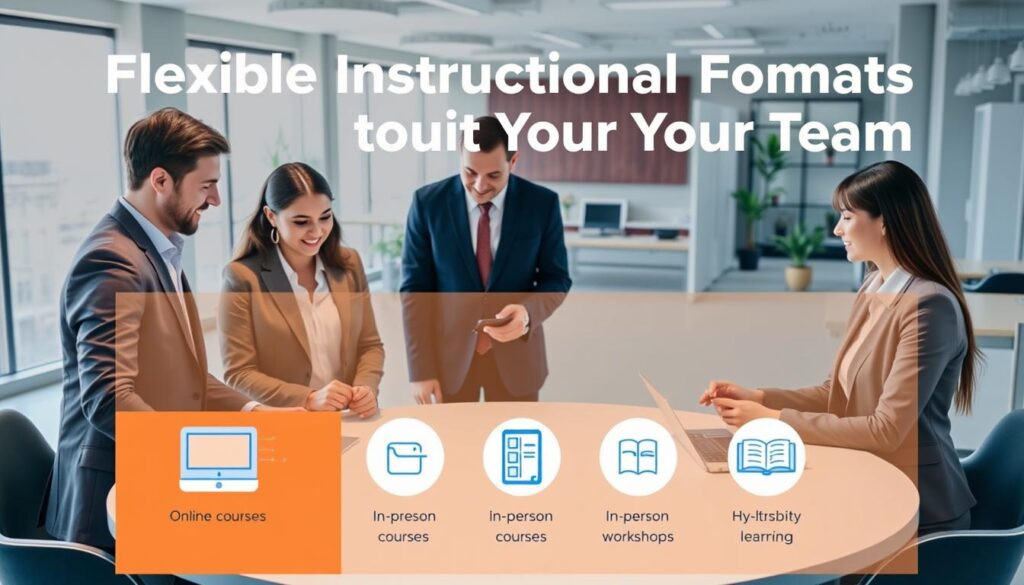
One size rarely fits all when it comes to developing new skills across an entire organization. Modern teams have diverse scheduling needs and learning preferences.
Logistical constraints can make traditional education challenging. The right delivery method removes these barriers to participation.
ADDA’s approach offers multiple pathways. You can select the format that best matches your team’s structure and goals.
This client-centric philosophy ensures maximum engagement. Every learner can participate in a way that works for them.
Immersive In-Person Workshops in Jakarta
Face-to-face sessions create powerful, focused environments. Teams gather in dedicated spaces free from daily distractions.
These workshops are ideal for complex, hands-on exercises. Participants can manipulate physical materials and collaborate directly.
Executive off-sites benefit greatly from this format. Leadership teams build cohesion while exploring strategic concepts together.
One participant shared their experience with this approach.
“The in-person workshop transformed how our department collaborates. Being together in one room sparked conversations that virtual meetings never could.”
Local facilities in Indonesia’s capital provide professional settings. Your team gains uninterrupted time to deepen their understanding.
Interactive Live Virtual Training Sessions
Geography should never limit skill development. Live virtual sessions connect dispersed teams in real-time.
Instructors engage participants through interactive elements. Polls, breakout rooms, and screen sharing keep everyone involved.
This format offers remarkable convenience. Team members join from their offices or homes without travel time.
It’s perfect for organizations with multiple locations. Everyone receives the same high-quality instruction simultaneously.
The virtual environment supports rich collaboration. Digital whiteboards and chat functions facilitate dynamic discussions.
Self-Paced Digital Learning and Blended Programs
Busy schedules demand flexibility. On-demand modules allow people to learn at their own pace.
Foundational knowledge can be acquired through digital courses. Team members complete modules when it suits their workflow.
Blended programs combine the best of both worlds. Self-directed study prepares learners for live, interactive sessions.
This approach respects individual time constraints. People absorb information when they’re most receptive.
The blended model reinforces concepts through multiple channels. Knowledge retention improves significantly with this method.
| Instructional Format | Best For | Key Features | Ideal Use Cases |
|---|---|---|---|
| In-Person Workshops | Team building, complex exercises, executive strategy | Hands-on activities, direct collaboration, distraction-free environment | Department-wide skill development, leadership off-sites, technical deep dives |
| Live Virtual Sessions | Geographically dispersed teams, quick skill updates | Real-time interaction, polls & breakout rooms, no travel required | Multi-location rollouts, regular knowledge refreshers, large group introductions |
| Self-Paced & Blended | Busy schedules, foundational knowledge, flexible participation | On-demand access, learn at own pace, combines digital & live elements | New employee onboarding, prerequisite learning, continuous professional development |
Formats can be mixed and matched creatively. A comprehensive program might begin with digital learning.
Teams could then join live virtual sessions for discussion. Finally, an in-person workshop solidifies key concepts.
This flexibility ensures your training investment delivers maximum value. Every team member engages with the material effectively.
The right combination respects how people actually work. It provides the tools they need in accessible formats.
Your organization’s unique structure determines the optimal blend. We help you design an approach that fits perfectly.
Learn from Industry Practitioners and Expert Educators
Imagine learning to navigate complex technology from someone who’s never actually used it in the real world. The quality of any educational program hinges directly on the people leading it. Your team deserves mentors who bring more than just textbook knowledge to the table.
According to ADDA’s Instructor Expertise framework, effective facilitators possess a unique blend of credentials. They combine hands-on implementation experience with certified teaching skills. This dual capability transforms abstract concepts into actionable insights.
Instructors with Real-World AI Implementation Experience
Your instructor should be a practitioner first. Look for facilitators who have built actual solutions for companies like yours. They’ve faced budget constraints, tight deadlines, and skeptical stakeholders.
These professionals share stories from the trenches. They explain what worked, what failed, and why. You get practical lessons that textbooks simply cannot provide.
One seasoned facilitator put it this way.
“The most valuable insights come from projects that didn’t go perfectly. Sharing those stories helps teams avoid common pitfalls and build resilience.”
This practical guidance is invaluable. It prepares your people for the messy reality of implementation. They learn to anticipate challenges before they become roadblocks.
Certified Professionals and Skilled Adult Learning Facilitators
Deep subject matter authority is only half the equation. The best expert also knows how to teach effectively. They understand adult learning principles and engagement strategies.
Certifications validate technical competency. They show a commitment to staying current in a fast-moving field. But teaching certifications are equally important for knowledge transfer.
Skilled facilitators make complex topics accessible. They use analogies, interactive exercises, and real-time demonstrations. Participants stay engaged and retain more information.
This combination ensures your investment delivers tangible returns. Teams don’t just hear about concepts—they learn to apply them immediately.
| Instructor Type | Primary Strength | Potential Limitation | Impact on Learning |
|---|---|---|---|
| Academic Theorist | Deep conceptual understanding | Limited practical application context | High on theory, low on implementation skills |
| Technical Specialist | Current tool mastery | May lack teaching methodology | Uneven knowledge transfer |
| Industry Practitioner-Educator | Real-world experience + teaching skills | Requires investment in dual development | Balanced, practical, and immediately applicable |
The right facilitators become true partners in your journey. They offer more than just information—they provide mentorship based on lived experience. Their stories and insights become as valuable as the official curriculum.
This approach contrasts sharply with programs led by purely academic instructors. While theorists offer valuable perspectives, they often lack the business context your team needs. Similarly, trainers without formal teaching skills may struggle to connect with diverse learners.
ADDA’s model bridges this gap intentionally. Every facilitator is both a certified subject matter authority and a skilled educator. This ensures your program is both credible and pedagogically sound.
Your people learn from guides who have walked the path themselves. They gain confidence knowing their mentors have faced similar challenges. This creates a more meaningful and effective educational experience for everyone involved.
Key Benefits of Investing in AI Training for Your Jakarta Business
The entire.
Then continue to 1
The HTML HTML content_poly.
Write a good text)
[Keyword.
–
. Write a0.
The finalize. Remember the sake.
initial and the second. A: [Please note and. I amr.
How We Measure the Success of Your Training Program
How do you know if your investment in skill development is actually paying off? Post-session surveys only tell part of the story. A reputable provider should be your partner in proving value, not just delivering content.
We establish clear learning objectives from day one. Then we track outcomes through a multi-layered framework. This approach moves beyond “happy sheets” to demonstrate real impact.
Our measurement system examines success at four distinct levels. Each tier builds upon the last to show comprehensive progress. You get a complete picture of your return on investment.
Level 1: Immediate Reaction and Engagement
We start by gathering feedback on content and delivery. This ensures the material resonates with your team right away. Engagement metrics help us refine the experience in real time.
Participants share what worked well and what could improve. We analyze this data to optimize future sessions. Your people’s initial reactions matter for long-term adoption.
Level 2: Knowledge and Skill Acquisition
Next, we measure actual learning against pre-defined objectives. Quizzes and practical assignments provide objective evidence. Certifications validate that new competencies have been developed.
This phase answers a critical question. Did your team gain the knowledge and skills we promised? Our analysis provides clear, data-driven answers.
“Measurement shouldn’t be mysterious. Good programs show you exactly what was learned and how it applies.”
Level 3: Behavioral Change on the Job
The true test happens weeks or months after sessions end. We observe how participants apply their new capabilities at work. Are they using different tools? Initiating projects differently?
Follow-up surveys and manager interviews provide valuable insights. We look for evidence of changed habits and approaches. This shows whether learning translated into different workplace behavior.
Key behavioral indicators include:
- Tool adoption rates across departments
- Process innovation initiated by participants
- Collaboration patterns with new technology
- Problem-solving approaches using recently acquired methods
Level 4: Business Results and Impact
Finally, we connect educational outcomes to your key performance indicators. This is where investment truly proves its worth. We work with you to identify relevant metrics.
Common areas where impact becomes visible include:
| Business Area | Potential KPI Improvements | Measurement Approach |
|---|---|---|
| Operations | Reduced process time, lower error rates | Before/after time studies, quality audits |
| Sales & Marketing | Increased lead quality, higher conversion rates | Pipeline analysis, campaign performance tracking |
| Customer Experience | Improved satisfaction scores, faster resolution | Survey results, support ticket analysis |
| Innovation | More implemented ideas, shorter development cycles | Project tracking, idea implementation rates |
ADDA’s focus on measurable impact guides this entire process. Our assessment programs validate that the approach works. You receive concrete evidence of your program’s effectiveness.
This comprehensive framework turns uncertainty into clarity. You can confidently report results to stakeholders. The value of your educational investment becomes undeniable.
Remember, quality development should deliver more than information. It should change how your organization operates. The right measurement approach proves that transformation is happening.
What Other Organizations Are Saying
When choosing an educational partner, nothing speaks louder than the success stories of those who’ve walked the path before you. Social proof provides powerful validation that theoretical benefits translate to real-world impact.
Hearing from peers in similar industries builds immediate confidence. Their challenges likely mirror your own. Their achievements show what’s truly possible with the right approach.
Victor Aguero from PNUD/MICI shared his team’s experience after a course on practical applications. “We got to use the tools,” he noted simply. This direct hands-on guidance transformed theoretical knowledge into practical capability.
Effective testimonials highlight specific outcomes rather than generic praise. They mention time saved, problems solved, or new capabilities gained. This concrete evidence demonstrates measurable return on investment.
Different perspectives provide a complete picture. Executives discuss strategic value and organizational transformation. Managers highlight team performance improvements and workflow changes.
Individual contributors share personal skill development stories. Together, these voices create compelling evidence of program effectiveness.
“The practical focus gave our administrative staff immediate tools they could apply. We saw efficiency improvements within weeks of completing the program.”
Consider what each type of testimonial reveals about a program’s value. The table below shows how different feedback addresses various stakeholder concerns.
| Testimonial Source | Primary Focus | Key Outcomes Highlighted | Value for Decision-Makers |
|---|---|---|---|
| Senior Executives | Strategic alignment & ROI | Organizational transformation, competitive advantage gained | Confirms program supports business objectives and delivers measurable value |
| Department Managers | Team performance & adoption | Workflow improvements, skill application rates, collaboration enhancements | Demonstrates practical implementation success and team readiness |
| Technical Professionals | Tool mastery & capability | Hands-on proficiency, problem-solving abilities, technical confidence | Validates depth of learning and practical skill development |
| Administrative & Support Staff | Daily application & efficiency | Time savings, error reduction, process simplification | Shows widespread impact across all organizational levels |
These real-world accounts provide evidence that discussed benefits actually materialize. They turn promises into proven results you can expect for your own team.
Imagine your organization appearing in a similar testimonial section. Your leaders could discuss strategic gains from better decision-making tools. Your managers might describe more efficient departmental operations.
Your technical staff could share their newfound ability to build custom solutions. This vision becomes achievable with the right educational partnership.
Peer validation offers more than reassurance. It provides a realistic preview of your potential outcomes. Listening to those who’ve succeeded shows you the path forward.
Schedule Your AI Mapping Consultation with Dee Today
.
1. The first-script
We should contain only a.
Conclusion
The future of your enterprise isn’t written by chance, but by the capabilities you choose to build today. Proactive development in artificial intelligence is the most effective path to harness this power responsibly.
This journey begins with a solid foundation of understanding for your entire team. From there, specialized skills and strategic leadership can flourish.
A tailored, practical approach led by expert practitioners makes all the difference. It turns theoretical machine learning into tools your people can use.
The benefits are clear: sustained innovation, greater efficiency, and a powerful competitive edge. This investment future-proofs your entire operation.
Starting can feel daunting, but the path is clear. It begins with a conversation to map your unique needs and opportunities.
Take that decisive first step. Reach out for a friendly consultation to secure your business’s future. You now have the knowledge to advance your team’s capabilities with confidence.