
Is your company truly prepared for the financial reality of integrating advanced intelligence into its operations? Many leaders approach this critical decision with outdated assumptions, leading to budget surprises and stalled projects.
The landscape for professional advisory in artificial intelligence has matured significantly. It now focuses on strategic planning and business alignment, not just technical execution. This evolution directly impacts the investment required.
Your commitment to this expertise represents a strategic move to accelerate digital transformation. Understanding the factors that drive pricing is essential to maximizing your return. The final figure depends heavily on experience level, project scope, and the chosen engagement model.
You can access this specialized knowledge through various channels, from large firms to boutique specialists. Each offers a different value proposition and rate structure. Selecting the right partner is crucial for your project’s success.
For personalized guidance on budgeting your specific initiative, you can discuss your transformation project directly with Dee Ferdinand via Whatsapp at +6281289633588.
Key Takeaways
- Expert advisory fees vary dramatically based on consultant experience and project complexity.
- The modern focus is on strategic roadmapping, which often commands a premium.
- Your investment should be viewed as a strategic decision to accelerate business transformation.
- Multiple channels exist for accessing expertise, each with different pricing models.
- Understanding the total value delivered is more important than just the hourly rate.
- Proper partner selection is critical for achieving your project goals.
- Personalized budgeting advice is available for your specific business needs.
Introduction: The Growing Importance of AI Consulting

The business landscape is undergoing a seismic shift as artificial intelligence becomes integral to competitive strategy. What was once experimental technology now separates market leaders from followers across industries.
Modern AI Adoption Trends
Your organization faces mounting pressure to implement intelligent solutions. Research shows 82% of companies plan to adopt AI agents within three years. This creates a competitive environment where early movers gain significant advantages.
The consulting industry for artificial intelligence is experiencing explosive growth globally. Regions like India show 30.2% compound annual growth rates. This indicates massive demand for specialized expertise.
Why Your Business Needs AI Transformation
Your competitors are already leveraging intelligent systems to reduce costs and enhance customer experiences. They’re optimizing supply chains and unlocking new revenue streams. Comprehensive transformation strategy is now imperative for your business survival.
Professional guidance helps identify high-value use cases and assess technical feasibility. You gain access to specialized knowledge that would take years to develop internally. This accelerates your time-to-value while reducing implementation risks.
Modern requirements extend beyond basic automation to strategic decision-making and predictive analytics. Machine learning development and continuously improving systems represent the new standard. Expert consulting ensures your transformation aligns with strategic objectives.
Understanding “How much do AI consulting services cost?”

Budgeting for specialized guidance begins with mastering the language of professional fees. The terminology used by experts directly impacts your financial planning and engagement success.
Key Pricing Terminologies Explained
You encounter several fee structures when evaluating advisory services. Hourly rates provide flexibility for short-term needs. Project-based fees offer budget certainty for defined outcomes.
Retainer agreements support ongoing partnerships. Value-based pricing ties compensation directly to your business results. Each model serves different project requirements.
Breaking Down Fee Structures
Your investment encompasses more than consultant time. It includes strategic frameworks, methodology, and analytical capabilities. These elements deliver transformational value beyond basic advisory.
Proper terminology understanding prevents budget surprises. You can compare proposals effectively when you grasp terms like deliverables and success metrics. This knowledge ensures alignment between expectations and reality.
The right pricing model matches your project characteristics and organizational needs. Your selection should reflect both immediate requirements and long-term strategic goals.
Factors Influencing AI Consulting Pricing

The final figure for strategic guidance is not arbitrary but driven by a combination of distinct factors. These elements interact to shape your investment.
Recognizing these variables helps you understand the value proposition behind different pricing proposals.
Experience and Expertise
Consultant experience remains the strongest predictor of advisory rates. Senior experts command significantly higher fees than their junior counterparts.
This premium reflects their refined strategic judgment and ability to navigate complex challenges. Specialized knowledge in areas like machine learning also adds value.
Project Scope and Complexity
Your project’s demands directly influence costs. A simple automation task requires less investment than a comprehensive initiative.
Complex projects involving custom development, vast data sets, and multiple integrations naturally cost more. The planning phase is crucial for defining scope boundaries.
Industry and Domain-Specific Factors
The industry you operate in introduces specific pricing considerations. Expertise in highly regulated sectors like healthcare carries a substantial premium.
Your consultant’s deep understanding of your domain’s unique needs and technology landscape is a critical asset. This specialized knowledge ensures solutions are tailored and effective.
Overview of Pricing Models in AI Consulting
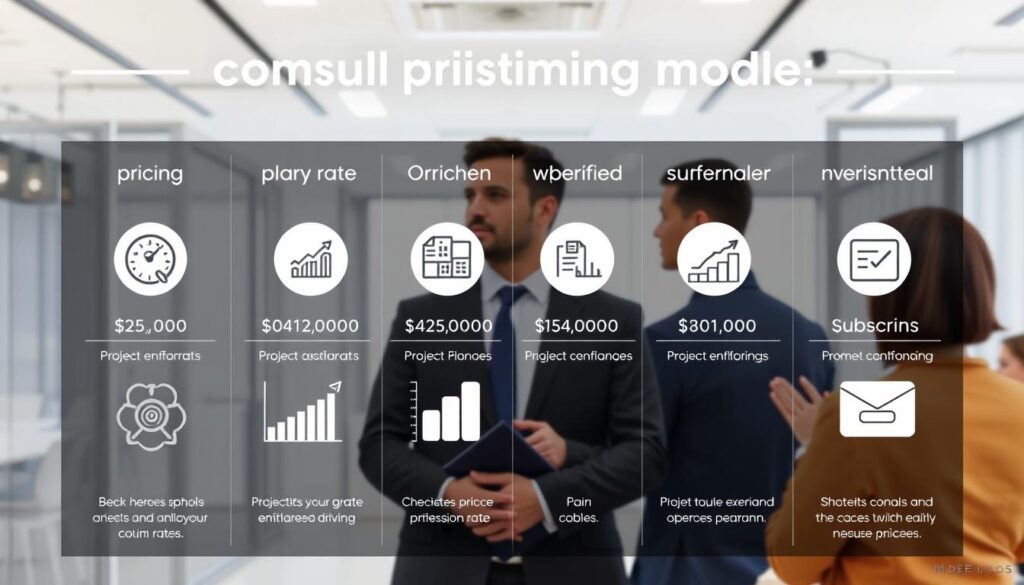
Navigating the landscape of professional fee structures requires understanding four primary engagement models. Each approach offers distinct advantages for different project requirements.
Your choice among these frameworks significantly impacts budget predictability and consultant alignment. The right selection matches your specific needs and risk tolerance.
| Pricing Model | Best For | Cost Range | Key Consideration |
|---|---|---|---|
| Hourly Rates | Exploratory work, short-term needs | $100-$500+/hour | Flexible but unpredictable total costs |
| Project-Based | Clear deliverables, defined scope | $5,000-$500,000+ | Budget certainty with fixed outcomes |
| Retainer Agreements | Ongoing strategic guidance | $2,000-$50,000/month | Guaranteed availability and support |
| Value-Based | Measurable business outcomes | 10-40% of value created | Perfect incentive alignment |
Hourly Rate Model
This approach charges for actual time spent on your initiative. Junior experts typically bill $100-$150 per hour. Senior professionals command $300-$500 or more.
The model provides maximum flexibility for undefined exploratory work. However, it creates uncertainty about total project investment.
Project-Based Fees
Fixed-price arrangements establish clear budget parameters. Small strategy assessments range from $5,000-$25,000. Comprehensive transformations can reach $500,000+.
This model delivers budget certainty with well-defined deliverables. It works best when scope boundaries are clearly established.
Retainer and Value-Based Pricing
Retainer agreements guarantee ongoing support. Essential packages (5-10 hours monthly) cost $2,000-$5,000. Comprehensive partnerships run $15,000-$50,000 per month.
“The shift toward outcome-based compensation reflects client demand for tangible business impact rather than time-based billing.”
Value-based models tie fees directly to your results. They typically represent 10-40% of measurable cost savings or revenue increases.
AI Consultant Cost Range Breakdown

Your investment in professional guidance varies significantly based on the expert’s background and the project’s scale. Understanding these ranges helps you allocate your budget effectively.
Junior vs. Senior Consultant Rates
Experience level is the primary driver of consultant rates. Professionals with more years of experience command higher fees due to their refined judgment.
The table below illustrates typical hourly rates based on experience.
| Experience Level | Years of Experience | Typical Hourly Rate |
|---|---|---|
| Junior Consultant | 0-3 years | $100-$150 |
| Mid-Level Consultant | 3-7 years | $150-$300 |
| Senior Consultant | 7+ years | $300-$500+ |
Experts who combine deep technical knowledge with strategic business acumen often command a premium of 40-60% over base rates. Their ability to bridge both domains delivers superior value.
Cost Differentials Across Engagement Sizes
The total project cost is also determined by the number of hours required. Smaller initiatives might need just 20-50 hours.
This translates to an investment of $5,000-$25,000. Larger transformations can consume 500+ hours, with costs reaching $100,000-$500,000.
Selecting the right consultant involves balancing expertise requirements with your budget. Mid-level consultants often provide an optimal balance for many projects.
Regional Variations in AI Consulting Costs

Geographic arbitrage presents significant opportunities for optimizing your professional guidance budget across different global markets. The location of your expert advisor dramatically influences the final investment required.
North American advisors command the highest rates globally. US-based experts typically charge 25-35% more than Canadian counterparts. Major tech hubs like Silicon Valley and New York City demand additional 15-30% premiums.
North America vs. Asia-Pacific
The Asia-Pacific region shows the widest pricing range for strategic guidance. Japanese advisory fees run 2-3 times higher than Indian alternatives. Despite explosive 30.2% growth rates, India maintains highly competitive pricing that attracts international businesses.
European markets display significant East-West divisions. Western European countries command 50-70% higher rates than Eastern European alternatives offering comparable technical skills.
Impact of Local Market Conditions
Your local economic environment directly affects advisory pricing. Consultants in major tech hubs command premiums due to higher living costs and competitive talent markets.
Remote engagement models typically reduce costs by 20-40% compared to on-site equivalents. This allows your company to access global talent pools without geographic constraints.
Hybrid models combining initial on-site strategy with remote implementation offer balanced value. They typically add only 10-20% premiums over fully remote arrangements while capturing benefits of both approaches.
Comparing Hourly, Project-Based, and Retainer Models

Selecting the right pricing framework represents a critical strategic decision that directly impacts your project’s success and financial outcomes. Each engagement model offers distinct advantages tailored to different business scenarios and risk profiles.
The choice between these approaches depends heavily on your project’s clarity and your organization’s specific needs. Understanding the trade-offs helps you maximize value while managing budget constraints effectively.
Advantages and Limitations of Each Model
Hourly rates provide maximum flexibility for exploratory work where scope remains undefined. You pay only for actual time spent, though this approach creates budget uncertainty.
Project-based pricing delivers clear budget certainty with fixed costs established upfront. This model works best when you have well-defined deliverables and want predictable financial planning.
Retainer agreements ensure consistent advisor availability for ongoing strategic guidance. They offer predictable monthly costs but may result in paying for unused hours during slower periods.
Industry trends show 73% of clients now prefer outcome-based compensation models. This reflects growing sophistication in how businesses evaluate advisory value beyond simple time tracking.
Your selection should consider project scope clarity, risk tolerance, and desired relationship dynamics. The right model aligns consultant incentives with your strategic objectives for optimal results.
Evaluating Value-Based Pricing Strategies
Sophisticated organizations now demand pricing structures that directly correlate with measurable performance improvements. This represents a fundamental shift from traditional time-based billing toward outcome-focused compensation models.
Alignment with Business Outcomes
Value-based arrangements typically structure fees as 10-40% of quantifiable savings or revenue increases. This approach ensures advisors earn premium compensation only when delivering tangible results.
Perfect incentive alignment occurs when your success directly impacts advisor earnings. This eliminates the perverse reward system of hourly billing that values time over outcomes.
Your evaluation should recognize both advantages and requirements. This strategy rewards efficiency while demanding sophisticated tracking mechanisms and mutual trust between parties.
Case Examples from 2025 Trends
Recent research shows 73% of clients prefer models tied to measurable business outcomes. This trend dominates the consulting landscape as organizations seek greater accountability.
Compelling examples include retail companies paying 25% of cost savings from inventory optimization. Financial services firms share 30% of revenue increases from customer personalization initiatives.
Manufacturing businesses compensate based on measurable efficiency gains. These cases demonstrate the power of aligning advisor compensation with client success metrics.
Hybrid models combining modest fixed fees with value-based bonuses provide financial stability while maintaining strong incentive alignment. This balanced approach works well for long-term partnerships spanning multiple years.
Hidden Costs and Additional Considerations
Your initial investment in professional guidance represents only the visible portion of your total transformation budget. Several overlooked factors significantly impact your actual expenditure.
Initial strategy engagements frequently uncover areas needing deeper exploration. Follow-up work typically adds 15-30% to original project costs. This additional investment delivers substantial value through detailed implementation guidance.
Follow-Up Consultations and Strategy Refinement
Market conditions and competitive landscapes constantly evolve. Your strategy requires periodic reassessment rather than being treated as a one-time expense. Ongoing support ensures your initiatives remain aligned with business objectives.
Effective knowledge transfer from external experts to your internal teams determines long-term success. Organizations prioritizing structured knowledge programs report 60% higher sustained value three years after implementation.
| Hidden Cost Category | Typical Impact | Mitigation Strategy | Value Delivered |
|---|---|---|---|
| Follow-up Consultations | 15-30% cost increase | Clear scope definition | Implementation guidance |
| Strategy Refinement | Periodic 10-20% increments | Quarterly reviews | Market alignment |
| Knowledge Transfer | 5-15% additional investment | Structured programs | 60% higher long-term value |
| Opportunity Costs | 3.2x higher abandonment rates | Clear strategic direction | 67% faster time-to-value |
The most significant hidden expense is the opportunity cost of suboptimal strategy. Organizations without clear direction experience 42% higher implementation costs and substantially longer deployment timelines.
“Comprehensive planning must include data preparation, system integration, and change management initiatives that enable successful implementation.”
Your thorough upfront planning minimizes unexpected expenses. Realistic timeline expectations and explicit knowledge transfer requirements in agreements protect your investment. Successful transformation requires sustained commitment beyond the initial engagement period.
Case Studies: AI Consulting Costs Across Business Sizes
Real-world examples provide the clearest picture of investment requirements for artificial intelligence initiatives. These case studies demonstrate how project scope and complexity drive consulting expenses.
Small Business AI Implementations
Your smaller company typically focuses on targeted solutions with immediate returns. A $5 million e-commerce business invested $22,500-$60,000 for complete advisory support.
This covered opportunity assessment, strategic roadmap development, and technology evaluation. The project addressed specific inventory management and personalization tasks.
Small business engagements usually involve 1-2 consultants over 2-3 months. They deliver focused machine learning solutions for clear business challenges.
Enterprise-Level Transformations
Your large organization requires comprehensive intelligence systems across multiple departments. A Fortune 500 financial services firm committed $400,000-$875,000+ for enterprise-wide transformation.
This investment covered strategy development, center of excellence design, and governance frameworks. The project involved 8-15 consultant teams over 6-12 months.
Enterprise projects demand sophisticated data analysis and systems integration. They address complex business problems requiring extensive team training and development.
These examples show how companies of different sizes approach artificial intelligence adoption. Your investment should match your organization’s specific needs and ambitions.
Expert Advice: Maximizing Your ROI on AI Consulting
Your success with strategic initiatives is determined by both advisor selection and internal readiness. Proper preparation dramatically enhances the value you extract from external expertise.
Setting Clear Objectives
Define your business goals in measurable terms rather than technical specifications. Instead of requesting “machine learning capabilities,” specify “reduce operational costs by 25% through automated process optimization.”
This clarity guides strategy development and solution design. Quantifiable targets ensure alignment between your needs and consultant deliverables.
Optimizing Engagement Management
Complete thorough internal preparation before advisors begin their work. Conduct data inventory, stakeholder alignment, and infrastructure assessment.
Assign dedicated internal resources to partner with consultants throughout projects. This approach facilitates continuous knowledge transfer and ensures solutions reflect organizational realities.
| Optimization Strategy | Impact on ROI | Implementation Timeline |
|---|---|---|
| Clear Objective Setting | 67% faster value realization | Pre-engagement phase |
| Structured Planning Approach | 2.5x faster positive returns | Throughout project lifecycle |
| Dedicated Internal Team | 60% higher sustained value | From project initiation |
| Phased Implementation | Reduced risk, early wins | Execution phase |
Organizations using structured implementation methods achieve significantly better outcomes. Your investment yields maximum returns when supported by disciplined engagement management.
How to Vet and Select the Right AI Consultant
Effective vetting of potential advisors involves assessing their track record and approach to problem-solving. Your selection process determines the success of your transformation initiative.
Essential Qualification Areas
Evaluate consultants based on four critical areas. Technical credentials should demonstrate deep machine learning knowledge. Industry experience must align with your specific needs.
Look for proven methodology in artificial intelligence projects. The right consultant balances technical feasibility with business impact. Their approach should address your unique data requirements.
Red Flags to Avoid
Watch for consultants who focus only on technology without business context. Avoid those who cannot articulate their development methodology clearly.
Steer clear of promises about unrealistic timelines or outcomes. Quality consultants discuss past challenges openly. They provide specific case studies with measurable results.
For personalized guidance on selecting the right expertise for your project, discuss your transformation needs with Dee Ferdinand via Whatsapp at +6281289633588.
Conclusion
The ultimate success of your digital evolution hinges on effectively leveraging external knowledge to build sustainable internal capabilities. Your strategic partnership with experienced professionals accelerates learning while minimizing implementation risks.
Understanding pricing dynamics empowers smarter investment decisions that align with your specific business needs. The right approach balances immediate requirements with long-term capability development.
Your organization’s transformation journey requires expert guidance to navigate complex technology choices and implementation strategies. This partnership delivers measurable value beyond simple technical solutions.
For personalized recommendations tailored to your unique situation, discuss your project with Dee Ferdinand via WhatsApp at +6281289633588. This direct consultation ensures your investment delivers maximum returns.